Modern enterprise environments are facing massive pressure from cloud-native scalability, distributed architectures, real-time processing demands, infrastructure costs, and AI-driven workloads.
Systems are expected to handle more transactions, lower latency, higher resilience, and faster deployment cycles than ever before.
In this environment, runtime efficiency is no longer an optimization topic; it is a business-critical requirement.
Driven by these demands, the JVM has undergone a major evolution in performance, memory management, concurrency, startup optimization, and cloud execution behavior.
At the same time, artificial intelligence is beginning to reshape how Java systems are designed, developed, tested, and maintained.
Understanding modern Java today means understanding far more than syntax. It means understanding how runtime architecture, scalability, infrastructure efficiency, and AI-assisted engineering are redefining the future of enterprise software development.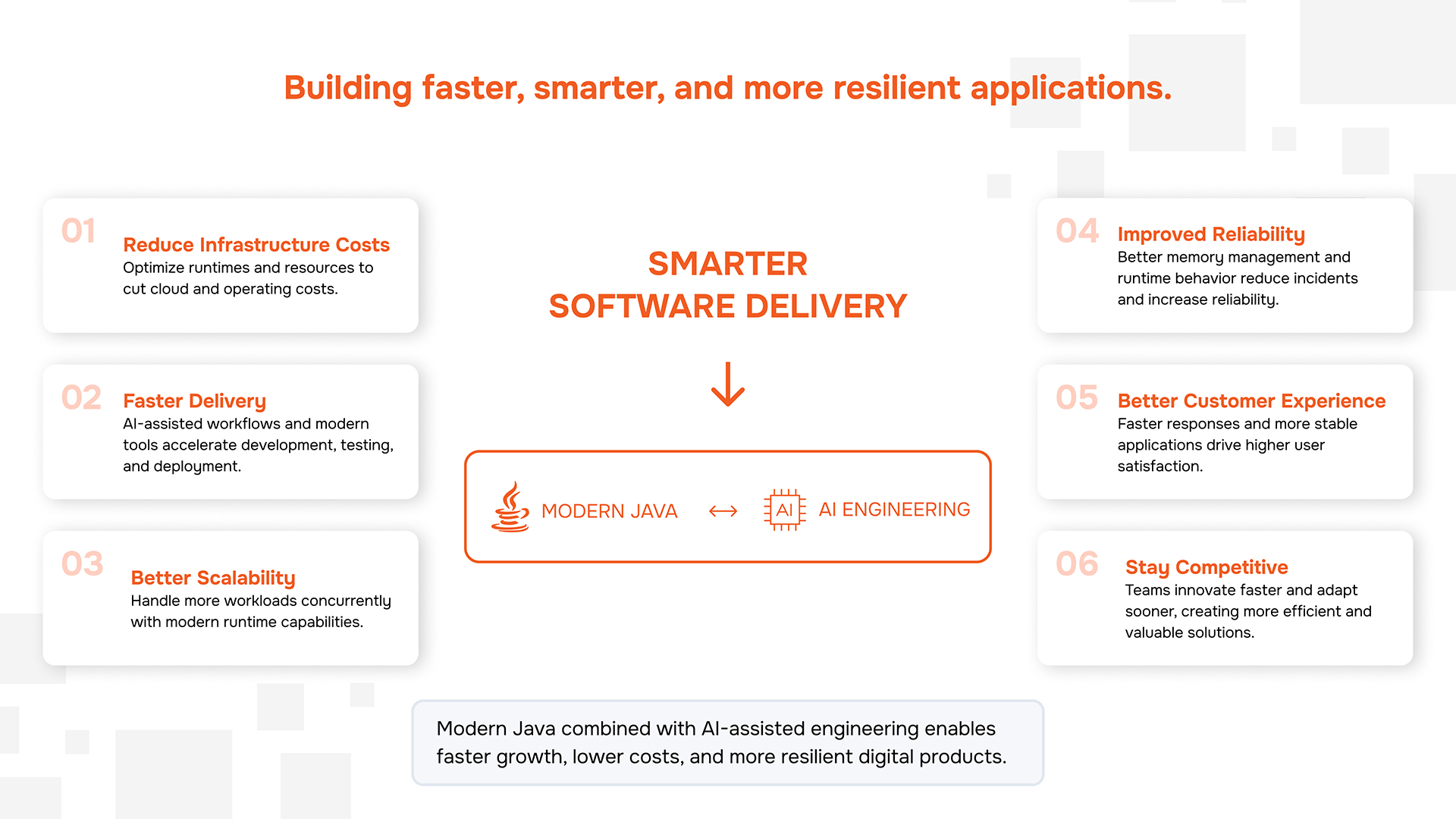
Part 1: The Runtime Revolution
Why Traditional Java Threads Became a Scalability Problem
Traditional Java threads worked well for years, but modern cloud-native applications often need to process massive numbers of simultaneous requests across APIs, databases, integrations, and external services.
The traditional threading model introduced serious scalability limitations. Each thread consumed operating system resources and memory, creating infrastructure pressure, context-switching overhead, and rising cloud costs under heavy workloads.
To scale these systems, teams were often forced to adopt highly complex asynchronous programming models, increasing development complexity and long-term maintenance effort.
Project Loom introduces Virtual Threads, lightweight JVM-managed threads designed to handle concurrent operations far more efficiently.
For businesses, this means:
- better scalability for high-traffic systems,
- lower infrastructure pressure,
- simpler and more maintainable codebases,
- and improved developer productivity.
The important nuance is that Virtual Threads are not designed to make CPU-heavy workloads faster. Their value lies in improving scalability and operational efficiency for I/O-heavy enterprise systems.
Startup Optimization & GraalVM
Traditional JVM applications are optimized during runtime through Just-In-Time compilation. While this provides excellent long-term performance, it also creates slower startup times and higher initial memory usage.
In cloud-native and serverless environments, startup speed directly affects scaling responsiveness, deployment efficiency, and infrastructure costs.
GraalVM Native Image changes this model through Ahead-of-Time compilation, allowing Java applications to start significantly faster and consume fewer resources.
For businesses, this improves:
- cloud efficiency,
- container scaling,
- startup responsiveness,
- and infrastructure optimization.
The tradeoff is reducing runtime flexibility, meaning some dynamic Java features require additional configuration.
Why Memory Management Became a Stability Problem
As enterprise systems scaled, memory management became more than a technical optimization issue.
Traditional garbage collectors introduced “Stop-the-World” pauses, temporarily freezing applications during memory cleanup. Under heavy workloads, these pauses could create latency spikes, unstable responsiveness, failed transactions, and degraded customer experience.
For businesses, this directly impacts:
- platform reliability,
- SLA compliance,
- transaction stability,
- and customer satisfaction.
Generational ZGC, fully production-ready in Java 21, dramatically reduces pause times by performing most cleanup operations concurrently while applications continue running.
This allows enterprise platforms to maintain more stable responsiveness under heavy load, especially in high-throughput environments.
Part 2: The AI Integration Reality
Developer Velocity & AI Copilots
Enterprise Java development has historically involved enormous amounts of repetitive work: boilerplate code, testing scaffolding, debugging, and infrastructure setup.
Modern AI development tools such as GitHub Copilot, Claude, and JetBrains AI are beginning to transform these workflows. Because Java is strongly typed and structurally predictable, AI tools are particularly effective at accelerating repetitive development tasks.
For businesses, this means:
- faster delivery cycles,
- improved engineering productivity,
- reduced repetitive work,
- and faster onboarding for development teams.
However, AI still does not understand business context, architecture strategy, or production risk the way experienced engineers do.
The role of developers is therefore evolving from pure implementation toward architecture, validation, scalability design, and engineering oversight.
AI Integration Inside the Java Ecosystem
Early enterprise AI adoption often forced organizations to introduce separate Python-based AI services alongside their Java platforms, increasing operational complexity and maintenance overhead.
The Java ecosystem responded rapidly with frameworks such as LangChain4j and Spring AI, allowing enterprise Java applications to integrate AI capabilities directly into existing JVM ecosystems.
For businesses, this simplifies AI adoption while reducing architectural fragmentation and operational complexity.
At the same time, AI integration introduces new challenges around validation, monitoring, and reliability, especially because AI-generated outputs are inherently non-deterministic.
Conclusion: The Modern Blueprint
The competitive Java team today does not look like the Java team of five years ago.
Syntax improvements may make code cleaner, but runtime efficiency and AI-assisted engineering increasingly determine how scalable, stable, and cost-efficient enterprise platforms can become.
Runtime innovations such as Virtual Threads, GraalVM Native Images, and Generational ZGC directly impact cloud infrastructure costs, platform scalability, deployment efficiency, runtime stability, and customer experience.
At the same time, AI-assisted engineering is transforming software delivery by accelerating development workflows and reducing repetitive engineering effort.
For CTOs and business leaders, these shifts are becoming strategic priorities.
Organizations that ignore runtime modernization risk operating increasingly expensive, slower, and less scalable platforms. Teams that ignore AI-assisted engineering risk slower delivery cycles and reduce competitiveness against organizations capable of adapting faster.
Runtime efficiency and AI-assisted engineering are no longer simply technical advantages. They are becoming competitive business advantages.